
The Transition to Leadership
By Mathis Thoerrisen
The Role Changes Before Your Instincts Do
The promotion may happen in a day. The definition of success usually takes longer to change.
That is why the move from individual contributor to leader is so difficult. People are often promoted for being reliable, capable, productive, knowledgeable, or willing to take responsibility when something needs to get done. They earned credibility through their own work. Then the role changes, and the behaviors that made them successful are no longer sufficient on their own.
The challenge is well documented. In a Center for Creative Leadership study of 295 first-time managers, the most common leadership challenges were adjusting to people management and displaying authority, cited by 59.3% of participants; developing managerial and personal effectiveness, cited by 46.1%; and leading team achievement, cited by 43.4%. Delegation, accountability, communication, coaching, conflict, and working with different kinds of employees also appeared across the responses.
The point is not that every new leader struggles with the same things. It is that moving into leadership introduces a different set of problems than the ones that usually earned the promotion in the first place.
There is also a preparation gap. Gallup’s 2025 State of the Global Workplace report found that only 44% of managers globally said they had received management training. That statistic covers managers broadly, not only first-time managers, but it helps explain why so many people enter leadership with limited preparation for what the role actually asks of them.
Training matters, but I do not think training alone solves the transition. A new leader can learn how to delegate, give feedback, run a meeting, or set expectations and still struggle if they are judging themselves by the same definition of success they used as an individual contributor.
That is where the deeper shift begins.
As an individual contributor, value is often visible. You complete the work, solve the problem, handle the difficult client, or step in when something goes wrong. At the end of the day, you can usually point to something concrete and say, “I did that.”
Leadership makes contribution less direct. The leader may still do significant technical work, but their responsibility also extends to the conditions that make good work possible: clarifying priorities, addressing problems at the appropriate level, and giving people the support they need to make sound decisions. They must keep the team moving toward the outcome the organization needs while noticing whether the surrounding conditions are helping or hindering performance.
That creates an uncomfortable gap. The role has changed, but the instinct to prove value through personal effort often remains.
A new leader may keep the hardest work because that still feels like contribution. They may hesitate to delegate, feel they should know more than the people they lead, or stay too close to every decision because responsibility feels safer when paired with control. They may finish a day full of coaching, removing barriers, and making judgment calls and still wonder what they actually accomplished.
None of these reactions automatically mean someone is a poor leader. They often mean the person is still applying an individual-contributor definition of success to a role that now requires something broader.
The transition to leadership therefore starts before any specific leadership technique. It starts with a change in perspective. The question is no longer only, “How well can I do this work?” It becomes, “What does this situation require from me now that I am responsible for helping other people succeed?”
That question will not always have a simple answer. Leadership may call for direct intervention, or for the restraint to let someone else work through a problem. At times, the responsibility is to make the decision; at others, it is to create enough clarity and support for someone else to make it well. The most valuable contribution might be visible execution, but it could just as easily be a difficult conversation, a timely judgment call, a needed resource, a clear boundary, or a problem prevented before anyone else notices it.
Learning to recognize those moments is part of becoming a leader. Before developing the individual skills that leadership requires, a person first has to notice when the situation is asking them to think differently than they did before.
From Personal Output To Broader Responsibility
One of the first places this different way of thinking becomes necessary is in how a leader defines contribution.
For an individual contributor, responsibility and output are usually closely connected. You perform the work, and the quality of the result is tied directly to your actions. That makes contribution easy to see: what you completed, solved, improved, and where your effort made a difference.
Leadership stretches that relationship. Responsibility expands beyond the work you personally produce. You may be accountable for a result that depends on several people, competing priorities, limited resources, decisions made by others, and circumstances you cannot fully control. Your contribution becomes less about owning every piece of execution and more about helping the whole system produce the right outcome.
That can feel surprisingly uncomfortable for people who became leaders because they were strong individual contributors. When personal output has been the clearest proof of value for years, familiar and measurable work can become reassurance that you are still contributing.
This is one reason new leaders can become overloaded even when they know they need to delegate. They keep the hardest assignments, step into problems quickly, or take work back when progress feels slow. Often, they are reverting to a familiar pattern of performance and using personal output to demonstrate value.
I recognized that concern in my own early leadership experience. I was not primarily worried that other people would make mistakes. I was worried that if I handed off too much of the work, the people around me might think I was not pulling my weight.
That belief made sense in the environment where much of my leadership identity had developed. In professional kitchens, credibility is often closely tied to visible effort and technical capability. Especially when I was younger, I felt that being accepted as a leader required showing that I could work as hard as anyone else and perform at a high level myself. Working harder felt like evidence that I deserved the responsibility.
The problem was not the work ethic. The problem was carrying the same definition of contribution into a role where my responsibility had become broader.
A leader still needs to work hard, understand the work well enough to make sound judgments, and step into execution when the situation requires it. But leadership cannot be measured by whether the leader personally produces more than everyone around them. That standard eventually puts the leader in competition with the people they are supposed to enable.
The shift is not from doing work to avoiding work. It is from treating personal output as the primary evidence of leadership value to treating the conditions you create for others as an equally important measure of contribution.
Broader responsibility changes what useful work can look like. A leader may create more value by clarifying a priority, finding a missing resource, removing an obstacle, or deciding which problem does not need to be solved yet. Those contributions may not provide the immediate satisfaction of completing the work yourself, but they can have a much larger effect on the outcome.
This also changes how leaders have to think about time. An individual contributor can often ask, “What should I work on next?” A leader has to ask a broader question: “Where is my involvement most useful?” Those questions may produce very different answers.
Sometimes the answer will still be direct execution. Leadership roles vary, and many leaders remain close to the specific tasks and processes. A small team leader, a working manager, or someone leading through a crisis may need to contribute directly for significant portions of the day. There is nothing inherently wrong with that. The more important question is whether the leader is doing the work because the situation genuinely requires it or because producing something personally still feels like the safest way to prove their value.
Responsibility does not shrink when a leader steps away from execution. The leader must still understand whether the work is moving in the right direction, whether people have what they need, and whether important problems are being surfaced. They remain accountable for outcomes they may only partially produce themselves.
That can initially feel like doing less while being responsible for more. In reality, it is a different kind of work.
One of the useful reflections for a new leader is therefore not simply, “Am I delegating enough?” It is more fundamental: “What am I still using as proof that I am valuable here?”
If the answer is being the person who works the longest, solves the hardest problem, knows the most, or produces the most visible output, the transition may still be incomplete. Those strengths do not suddenly become weaknesses, but they have to become part of a larger definition of contribution.
Leadership starts to look different when success includes what becomes possible because of your involvement, not only what you personally completed. That creates the next challenge in the transition. If the leader no longer has to be the person doing the most work, do they still need to be the person who knows the most?
From Expertise To Judgment
For many new leaders, the answer feels as though it should be yes. If you are responsible for the work, it seems reasonable that you should understand it better than the people you lead. Expertise feels connected to credibility, and credibility feels connected to the right to make decisions. In some roles, that connection matters. But being the most knowledgeable person in the room is not a requirement for successful leadership.
The expectation can still be difficult to let go of because expertise often helped earn the leadership opportunity in the first place. You may have become dependable because people came to you with questions, you solved problems quickly, or you noticed things others missed. When that knowledge has been part of your professional identity, leading people who know more than you do can feel intimidating. It can also tempt you to compensate by pretending to know more, inserting yourself into decisions unnecessarily, or avoiding situations where your knowledge feels incomplete.
The transition is not about deciding that expertise no longer matters. Leaders still need enough understanding to recognize risk, evaluate quality, ask useful questions, and know when something does not make sense. The shift is recognizing that expertise and leadership judgment are not the same thing.
Expertise helps you understand how something works. Judgment helps you determine what matters, what outcome you are trying to create, which information is relevant, whose expertise is needed, and what should happen next.
I learned this more clearly when I moved into my first corporate leadership role from another team. I understood the broader program and the environment around the work, but many of the people I was now leading knew the day-to-day operation better than I did. They had more direct experience with specific processes, client situations, and recurring problems. There was no realistic way for me to enter the role and immediately know everything they knew.
Trying to pretend otherwise would have made me less effective, not more credible.
I found myself saying some version of, “You know this better than I do,” and then asking people to explain what they were seeing, what they thought was causing the problem, and what options they believed were available. I had to become comfortable relying on expertise that did not belong to me.
That did not make leadership less necessary. It clarified what my contribution needed to be.
My role was to understand the outcome we were responsible for, listen closely enough to make sense of the situation, connect the information to broader priorities, assess the tradeoffs, and help the team move forward. At times, I made the decision myself. In other situations, the person closest to the work was better positioned to decide, and my responsibility was to make sure they had enough context and authority to do so well.
The important shift was realizing that leadership judgment is not always demonstrated by having the answer. It is often demonstrated by knowing how to get to a sound answer.
In practice, that starts with a few clear responsibilities. Understand the outcome. Identify what you do and do not know. Bring in the people who understand the relevant parts of the problem. Test the assumptions and tradeoffs. Then decide who should make the decision and make sure the path forward is clear.
That requires both humility and confidence. Humility allows a leader to admit that someone else may know more. Confidence allows the leader to keep moving without pretending that uncertainty has disappeared. Listening without ever reaching a conclusion creates drift. Deciding without listening creates a different problem. Good judgment requires both.
Leadership judgment is the ability to organize expertise around an outcome. The expertise may come from you, from someone on the team, or from several people who each understand a different part of the issue. The leader’s job is to bring those perspectives together well enough for the team to act.
This becomes more important as leadership responsibility grows. The larger the team or scope, the less realistic it is for one person to be the strongest technical expert in every area they oversee. A leader who insists on being the source of every answer eventually becomes a bottleneck. A leader who makes decisions confidently without understanding the work well enough creates a different kind of risk.
The goal is neither control nor detachment. It is informed involvement.
That distinction becomes especially important when decision-making is shared. A leader can give someone real ownership of a decision without giving away responsibility for the conditions around it. If a person lacks context, authority, support, or a reasonable opportunity to raise concerns, the leader cannot simply point to the delegated decision when the outcome goes wrong.
This is one of the harder parts of the transition to leadership. You will find yourself responsible for outcomes you did not personally produce and decisions you did not personally make. Once that becomes true, the question is no longer whether to stay involved. It is how much involvement the person and situation actually require.
Responsibility Without Total Control
That level of involvement will not be the same for every person or every situation.
A new employee learning unfamiliar work may need frequent conversation, clearer direction, and more active support. Someone with years of experience and a strong record may need very little from the leader beyond context, access to resources, and confidence that help is available when needed.
The problem is that leaders can misread both situations. Too much involvement slows decisions, weakens ownership, and teaches capable people to wait for approval. Too little involvement leaves people carrying responsibility without enough context, support, or access to the leader. The goal is not simply to step back. It is to stay close at the right level.
I think of this as the TRG RITE Method: Read the situation, Identify the approach together, Track what happens, and Evolve your involvement. The goal is not simply more or less involvement. It is getting the level of involvement RITE.
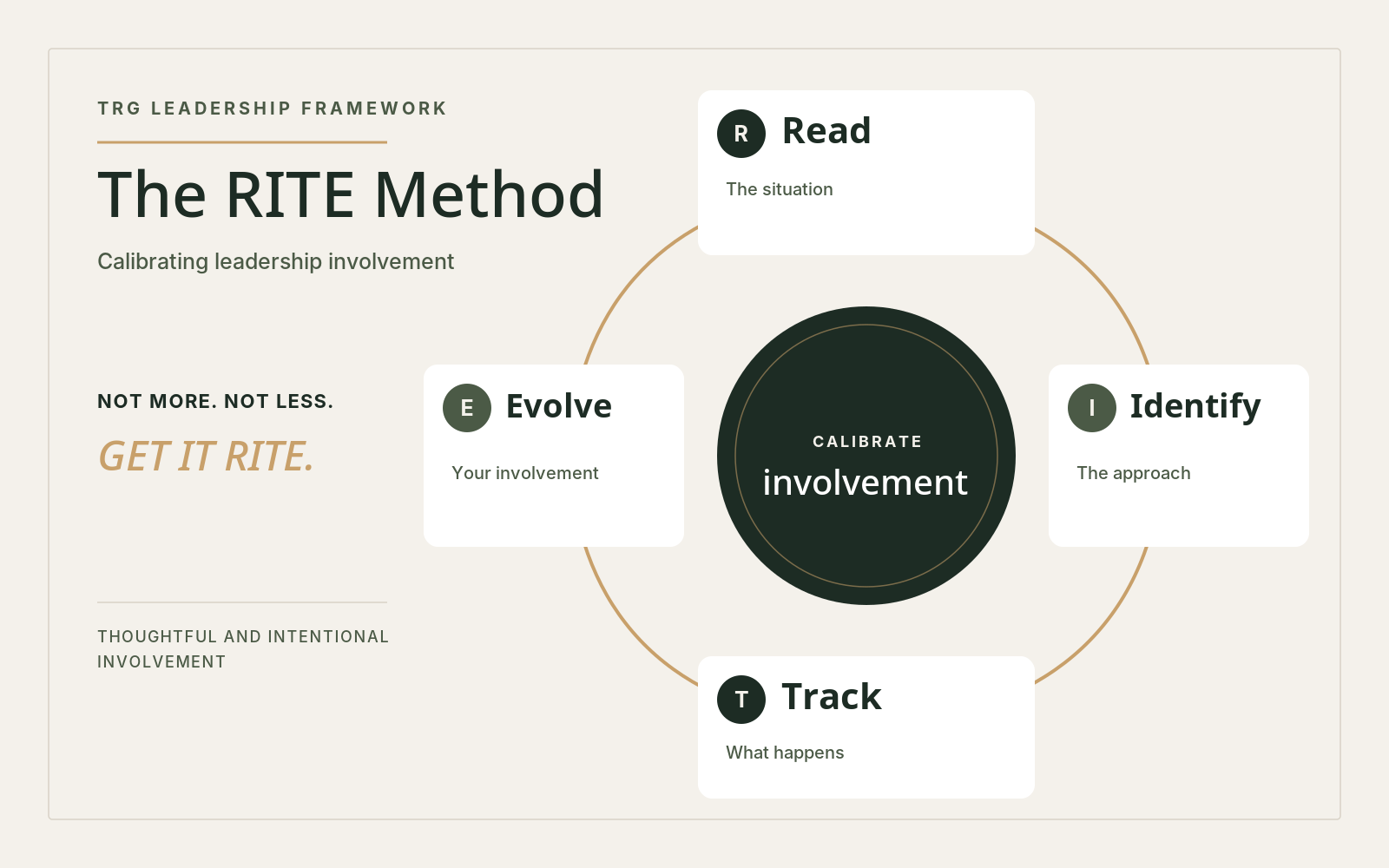
Read the situation. Consider the person’s experience with this type of work, how familiar the problem is, and how consequential the outcome may be. Someone can be highly capable overall and still need more support in an unfamiliar situation. The opposite is also true. A person who once needed close guidance may now be ready for much more independence. The starting point should come from the work and the person in front of you, not from a fixed idea of how closely a leader should manage.
Identify the approach together by creating shared understanding about how the work will move forward. This is less about defining a boundary for someone else and more about making sure both people are working from the same picture. What outcome are we trying to create? Where does the person feel ready to move independently? Where might the leader’s broader context, authority, or experience be useful? When would it make sense to reconnect?
Those conversations can reveal things in both directions. A leader may discover they are staying closer than the employee needs. An employee may surface a constraint or uncertainty the leader did not know existed. The purpose is to reduce guesswork about support, not to create more approval points.
Track what happens once that shared understanding exists. Is the work moving toward the intended outcome? Is the person making thoughtful decisions and surfacing meaningful risks? Are they asking for input when they need it? If the work is progressing well, there is little value in intervening simply because the leader would have approached it differently.
This is where new leaders sometimes have to separate discomfort from evidence. Watching someone solve a problem in a different way can create an instinct to step in even when nothing is actually wrong. The better question is whether the current level of involvement is helping the person and the work succeed.
Evolve your involvement as the evidence changes. If the work becomes more complex, the stakes rise, or the person begins to struggle, the leader can move closer. That support might mean asking questions, providing context, finding a resource, or making a decision that only the leader can make. Moving closer does not have to mean taking the work back.
The same principle works in the other direction. As someone demonstrates stronger judgment and greater comfort with the work, the leader can create more room for them to operate independently. Stepping back should not mean disappearing. It means changing the amount and type of support while remaining available when the situation calls for it.
What should remain constant is the leader’s accountability for creating reasonable conditions around the work. That does not make the leader responsible for every choice another person makes, and it does not remove the employee’s accountability for their own decisions. It means the leader cannot separate themselves completely from the environment in which those decisions were made.
Leaders will still misjudge the level of involvement sometimes. When that happens, the useful response is to look at the whole situation. Did the person have what they needed? Did the leader stay too close for ownership to develop, or too far away for the circumstances? What changed that should have prompted a different level of support? The goal is not to assign all responsibility in one direction. It is to learn enough from the outcome to adjust your involvement more thoughtfully next time.
The TRG RITE Method does not prescribe a fixed leadership style. It helps a leader stay accountable while changing the form of their involvement as the person and situation evolve. This is thoughtful and intentional involvement.
For many new leaders, the harder part is not understanding this intellectually. It is feeling secure enough to practice it. Allowing someone else to own the work can surface the same question that appeared earlier in the transition: if I am not doing the most, knowing the most, or controlling the most, what makes me credible as the leader?
That question moves the transition to leadership from how you manage the work to how you understand yourself in the role.
From Doing The Work To Creating The Conditions For The Work
Once a leader accepts that they cannot and should not control every decision, they have to widen their perspective beyond the individual decision or task in front of them.
People depend on clear expectations, useful information, workable systems, and a reliable way to raise problems. When the same issue appears across several people, a leader has to consider whether something around the work is contributing to it.
Imagine a team where several people keep missing the same step in a recurring piece of work. A leader could address each mistake individually, remind each person what should have happened, and move on.
But if the same mistake keeps appearing, the pattern deserves attention. Perhaps the expectation was never communicated clearly. The information people need may be difficult to find. Two processes may give conflicting instructions. Or the team may be relying on an informal habit that works inconsistently.
That does not mean every repeated problem is caused by a flawed system, or that individual performance no longer matters. The shift is learning to consider both.
This is where communication and systems become part of leadership. Their purpose is to give people enough clarity and access to information to do the work well without creating unnecessary dependence on the leader.
That does not require a process for every possible situation. Too much structure can create its own problems and replace judgment with rules. The goal is enough consistency to reduce avoidable confusion while still leaving room for people to think.
For someone accustomed to solving problems directly, the most useful contribution may sometimes be recognizing why the problem keeps returning.
The question becomes broader than, “What went wrong this time?”
It also becomes, “What around the work may be making this outcome more likely?”
Learning to ask that question is another important shift in perspective as someone moves into leadership.
Reflection: Where Are You In The Transition?
The transition to leadership can be difficult to judge from the inside because many of the habits that need to change are also the habits that helped you become successful.
One way to understand where you are is to pay attention to the situations that create the most discomfort or friction.
Contribution
Consider where you still feel a need to prove your value through personal output.
When other people are doing the visible work, do you feel as though you should be doing more yourself? Do you take work back because the situation requires it, or because completing it personally still feels like the clearest evidence that you are contributing?
Expertise
Notice what happens when someone else knows more than you do.
Can you rely on their expertise without feeling that your credibility is diminished? Are you comfortable asking questions, admitting what you do not know, and still taking responsibility for helping the team reach a sound decision?
Responsibility
Think about the situations where the outcome matters most.
Does responsibility create an instinct to stay involved in every decision? Where might you be staying closer than the person or situation actually requires? Where might you have stepped back without providing enough context or support?
Perspective
Consider how you interpret problems that keep returning.
If the same misunderstanding, obstacle, or delay shows up repeatedly, are you continuing to solve each instance separately, or have you begun to ask what the pattern may be telling you about the communication, structure, or systems around the work?
These questions are not meant to produce a leadership score. They are meant to help identify where your previous definition of success still has the strongest influence on how you lead.
The most useful reflection may be the question that creates some discomfort. You may realize that delegation still feels like doing less. You may notice that your confidence changes when someone challenges your expertise. You may find that accountability still feels closely connected to control. Or you may recognize that you have become good at helping people solve problems without yet noticing what is causing those problems to recur.
That recognition gives you somewhere to develop.
You do not need to address everything at once. Leadership develops through experience, reflection, and deliberate adjustment. The goal is to become better at noticing when your instinct belongs to the role you used to have rather than the responsibility you have now.
One question can help bring those reflections together:
What is this situation asking of me as a leader that it would not have asked of me as an individual contributor?
The answer will change with the person, the work, and the circumstances. Learning to notice the difference is part of the transition itself.
The Transition Is The Beginning
That question is meant to stay open.
What a situation requires from you will change with the people you lead, the work in front of you, and the responsibility you carry. The transition to leadership is not a stage you simply complete. It is the beginning of a different way of thinking.
The strengths that helped you become a leader still matter. Work ethic, expertise, problem solving, reliability, and high standards do not become less valuable because you are responsible for other people. Sometimes leadership will still require you to do the work yourself, know more than anyone else in the room, or make the decision personally. The challenge is learning not to default to those responses simply because they are familiar.
A leader has to become increasingly capable of asking what the situation actually requires. Is my involvement helping? Whose expertise matters here? Does this decision need to belong to me? Is the problem in front of me isolated, or is there something larger I should be noticing?
Those judgments improve through experience, but experience alone is not enough. It is possible to repeat the same leadership habits for years without examining whether they are working. Reflection is what allows experience to become development.
You will still stay too close to work someone else was ready to own, step back when more support was needed, make decisions with incomplete information, and fall back on familiar habits. Those moments are part of learning to lead.
The transition becomes real when you stop measuring leadership only by your own performance and start considering what your judgment, support, and involvement make possible for the people and work around you.
That is not the end of the transition. It is the practice of leadership.
